
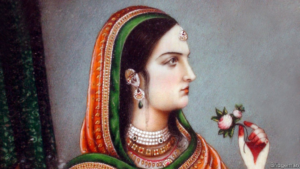
Painting of Nur Jahan
There have been many illustrious women in the history of India about whom we were taught when we were kids because they were extraordinary women who created history hundreds of years ago. But unfortunately, their final resting places did not receive the same attention and care they deserved. The story of Nur Jahan is unique because she was the only queen in the history of the Mughal empire who was called Badshah Begum meaning someone as important as the emperor himself.
Today I will bring to you the story of the most powerful Mughal Royal woman in the history of centuries of Mughal rule in India called Nur Jahan or the Light of the World. She was an extraordinarily beautiful and talented woman who was well-educated and became the power behind the throne of Jahangir. The world does not know much about the Mughals let alone Nur Jehan because all they know is Taj Mahal that was built by Emperor Shah Jehan for his wife Mumtajmahal in Agra, but the Mughals ruled India for many centuries starting with Babur and ending with the last Mughal emperor Bahadur Shah Jafar whom the British deposed after the first freedom struggle of 1857.
I will not get into the long story of Mughal rule in India here but focus on one extraordinary royal woman who made a place for herself in the history books by her sheer acumen, ability in political matters and her personality. Every Indian child knows about her place in Indian history.
Biography of Nur Jahan:
Nur Jahan (born Mehr-un-Nissa, 31 May 1577 18 December 1645[1]) was the twentieth (and last) wife of the Mughal emperor Jahangir.
Nur Jahan was born Mehr-un-Nissa, the daughter of a Grand Vizier (Minister) who served under Akbar. Nur Jahan, meaning Light of the World, was married at age 17 to a Persian soldier Sher Afghan, governor of Bihar, an important Mughal province. She was a married woman when Prince Salim (the future Emperor Jahangir), Akbars eldest son, fell in love with her. Two years after Akbar died and Salim became Emperor, Sher Afghan met his death. However, three more years were to pass before a grieving Nur Jahan consented to marrying the Emperor Jahangir.
Although Jahangir was deeply in love with Nur Jahan, their actual story bears no resemblance to the legend of Anarkali, a dancing girl who, according to popular folklore and film-lore, had a tragic and doomed love affair with Jahangir. Emperor Akbar could not allow a low-born dancing girl to marry the prince even if she was very pretty, so had her buried alive. In fact, the relationship between Jahangir and Nur Jahan was even more interesting in its time than the legend of Anarkali, for Nur Jahan was a teenager when the Emperor fell in love with her. Nur Jehan came from a very noble and illustrious family in Kandahar, which is in Afghanistan.
A school of historians still believe, though without credible evidence, that Jahangir (then called Salim) was already in love with Nur Jahan (then Mehr-un-Nisa) when she was initially married to Sher Afghan. Thwarted by Akbar in his attempts to marry her then, Jahangir plotted to get Sher Afghan killed on the pretext of treachery to finally marry Nur Jahan. However, this theory lacks sound evidence and seems far-fetched.
After her wedding to emperor Jahangir in May 1611, Nur Jahans rise to power was swift. A strong, charismatic, and well-educated woman who enjoyed the absolute confidence of her husband, Nur Jahan was the most powerful and influential woman at court during a period when the Mughal Empire was at the peak of its power and glory. More decisive and proactive than her husband, she is considered by historians to have been the real power behind the throne for more than fifteen years. Nur Jahan was granted certain honors and privileges which were not enjoyed by any Mughal empress before or after.
She was the only Mughal empress to have coinage struck in her name. She was often present when the Emperor held court, and even held court independently when the Emperor was unwell. She was given charge of his imperial seal, implying that her perusal and consent were necessary before any document or order received legal validity. The Emperor sought her views on most matters before issuing orders. The only other Mughal empress to command such devotion from her husband was Nur Jahans niece Mumtaz Mahal, for whom Shah Jahan built the Taj Mahal as a mausoleum. However, Mumtaz took no interest in affairs of state and Nur Jahan is therefore unique in the annals of the Mughal Empire for the political influence she wielded.
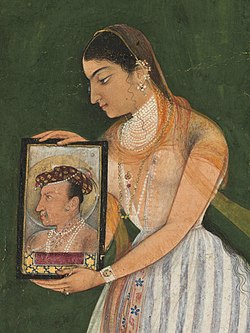
Nur Jahan holding a portrait of Emperor Jehangir
Birth and early life (15771594)
Kandahar, Nur Jahans place of birth, is now in southern Afghanistan. Nur Jahan was born Mehr-un-Nissa on 31 May 1577 in Kandahar, present-day Afghanistan, into a family of Persian nobility and was the second daughter and fourth child of the Persian aristocrat Mirza Ghiyas Beg and his wife Asmat Begum. Both of Nur Jahans parents were descendants of illustrious families Ghiyas Beg from Muhammad Sharif and Asmat Begum from the Aqa Mulla clan. Her paternal grandfather, Khwaja Muhammad Sharif, was first a wazir to Tatar Sultan the governor of Khurasan, and later was in the service of Shah Tahmasp, who made him the wazir of Isfahan, in recognition of his excellent service.
For unknown reasons, Ghiyas Begs family had suffered a reversal in fortunes in 1577 and soon found circumstances in their homeland intolerable. Hoping to improve his familys fortunes, Ghiyas Beg chose to relocate to India, where the Emperor Akbars court was said to be at the center of the growing trade industry and cultural scene.
Halfway along their route, the family was attacked by robbers who took from them their remaining meager possessions. Left with only two mules, Ghiyas Beg, his pregnant wife, and their two children (Muhammad Sharif, Asaf Khan) were forced to take turns riding on the backs of the animals for the remainder of their journey. When the family arrived in Kandahar, Asmat Begum gave birth to their first daughter.
The family was so impoverished, they feared they would be unable to take care of the newborn baby. Fortunately, the family was taken in by a caravan led by the merchant noble Malik Masud, who would later assist Ghiyas Beg in finding a position in the service of Emperor Akbar. Believing that the child had signaled a change in the familys fate, she was named Mehr-un-Nissa or Sun among Women. Her father Ghiyas Beg began his career in India, after being given a mansab of 300 in 1577. Thereafter, he was appointed diwan (treasurer) for the province of Kabul. Due to his astute skills at conducting business, he quickly rose through the ranks of the high administrative officials. For his excellent work he was awarded the title of Itimad-ud-Daulah or Pillar of the State by the emperor.
As a result of his work and promotions, Ghiyas Beg was able to ensure that Mehr-un-Nissa (the future Nur Jahan) would have the best possible education. She became well-versed in Arabic and Persian languages, art, literature, music and dance. The poet and author Vidya Dhar Mahajan would later praise Nur Jahan as having a piercing intelligence, a volatile temper and sound common sense.
Nur Jahan went hunting with the king and once saved his life when the king was attacked by a tiger. Nur Jahan, who was an expert shooter, shot the tiger. The second time, she saved her husband when a rebel general defeated them and put them in prison. She then sold her jewelry to raise an army that she commanded and defeated the rebel general to regain the throne.
After the death of Jehangir, Nur Jahan retired from active duty in the court and went to Lahore to live there the remainder of her life on a very generous income bestowed on her by the Emperor Aurangzeb, who was her great-nephew. It was Aurangzeb who put his father Shah Jahan in prison and had the heir to the throne Dara Shikoh assassinated to become the king, but he had great respect for Nur Jahan.
Later years and death (16281645)
Nur Jahan spent the remainder of her life confined in a comfortable mansion in Lahore with her daughter Ladli. She was granted an annual amount of 200,000 Rupees by Shah Jahan. In todays terms, it would amount to millions of dollars equivalent. During this period, she oversaw the completion of her fathers mausoleum in Agra, which she herself started in 1622 and is now known as Itmad- ud- daulahs tomb.

Mausoleum of Itmad ud Daula (father of Nur Jahan) in Agra
It is one of the finest example of Mughal architecture and glows like a jewel inside. In sheer craftsmanship, there is no equal to it anywhere. I have seen it myself.
Nur Jahans desire of being close to her husband even in death is visible in the proximity of her tomb to that of her husband, Jahangirs. Her brother Asaf Khans tomb is also located nearby. The tomb attracts many visitors, both Pakistani and foreign, who come to enjoy pleasant walks in its gardens.

Tomb of Jehangir in Lahore, Pakistan

Source : Google photo of the grave of Emperor Jehangir in Lahore, Pakistan

Tomb of Nur Jahan in Shahdara Bagh in Lahore, Pakistan

Grave of Nur Jahan in Lahore
You will notice the similarity between the tomb of Nur Jehan and of Jehangir except that the tomb of Nur Jehan has no minarets and is in a sad state of decay. It has now been designated as a world heritage site by UNESCO so it is being slowly restored to its original glory after suffering centuries of neglect.
Her simple grave without much decoration was her wish. Her daughter Ladli is buried next to her. The most powerful royal lady of the Mughal empire is buried here in all its simplicity, while the plasters fall off the walls and ceiling. Nur Jahan died on 17 December 1645 at age 68. She is buried at her tomb in Shahdara Bagh in Lahore, which she had built herself. Upon her tomb is inscribed the epitaph, On the grave of this poor stranger, let there be neither lamp nor rose. Let neither butterflys wing burn nor nightingale sing.
This is my modest effort to bring her story to the world. She deserves nothing less.