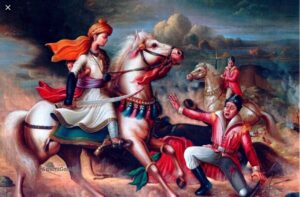
Queen Lakhsmi Bai of Jhansi in the battlefield
Lakhsmibai was born on November 19, 1828, in the holy city of Varanasi in a Brahmin Marathi family. She was named Manikarnika and was nicknamed Manu. Her father was Moropant Tambe (a retainer of Chimnaji Appa, brother of Baji Rao) and her mother Bhagirathi Sapre (Bhagirathi Bai).
Her parents came from Maharashtra. Her mother died when she was four years old. Her father worked for a district court in Peshwa Bithoor that brought Manikarnika as his own daughter. The Peshwa called it Chhabili, which means playful. She was educated at home and was more independent in her childhood than others of her age; her studies included shooting, horse riding and fencing.
Manikarnika was married to the Maharaja of Jhansi, Raja Rao Gangadhar Newalkar in May 1842 and was later named Lakshmi Bai (or Laxmibai) in honor of the Hindu goddess Lakshmi.
After the death of the Maharaja in November 1853 Damodar Rao the Prince was adopted, the British East India Company, under the governor general Lord Dalhousie, applied the doctrine of Accelerated, rejecting the request of Damodar Rao to the throne and the annexation of the State to its territories. In March 1854, Lakshmi Bai received an annual pension of Rs. 60,000 and was ordered to leave the palace and the fort.
Rani then prepared for the battle and issued a proclamation. We fight for independence in the words of Lord Krishna, if we are victorious, enjoy the fruits of victory, if vanquished and killed on the battlefield, we will surely gain eternal glory and salvation.
She defended Jhansi against British troops when Sir Hugh Rose besieged Jhansi on March 23, 1858. She lost the battle and fled to Kalpi to join other Tatya Tope forces, was followed by the British Army finally to Gwalior where she died from her wounds in battle and was cremated.
The British said that for all that her faults in the British eyes may have been, her compatriots will always remember that she was pulled by the mistreatment in the rebellion, and that she lived and died for her country. The queen of Jhansi is therefore remembered as one of the great and brave leaders who gave her life for the country. She was 30 years old when she died.
I visited the Jhansi fort during our tour of Jhansi. We were shown the rampart from where the Queen Lakhsmi Bai had jumped with her horse to the terrain below to escape from the British troops that had surrounded her fort. She sought help from other kings but did not succeed so she had no other option but to fight the British below the fort with her limited resources. The queen was outnumbered and faced a British army well-equipped, but she fought on and received mortal injuries. She took her last breath inside the fort, kneeling at the feet of her Deity in the temple.
The battlefield is now a weedy field where a marble statue of the queen on her horse stands in the middle of nowhere that is utterly neglected so we felt like crying seeing her statue. She was after all the great queen who stood up to the British and sacrificed her life.