
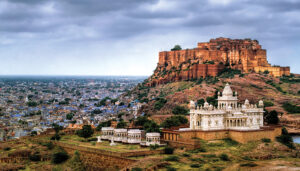
Numerous forts are found in the former feudal state of Rajasthan
When people value their honor and self-respect more than anything else, they are ready to shed their blood to preserve it. This has been the hallmark of the brave men and women of Rajasthan who sacrificed themselves for the sake of their honor. It made the sands of Rajasthan soaked with their blood. Such is their tragic history.
There is a state in India called Rajasthan that means a place of kings. It was a feudal state where there were numerous kingdoms vying for supremacy over their neighboring kingdoms, so they lived in almost constant state of warfare and fear of attack. So they built over 100 forts to protect themselves and their subjects. Some of these forts are so massive that will impress you until you are told of their bloody history. That will send a shiver down your spine, and you will have goose bumps.
Chittorgarh fort
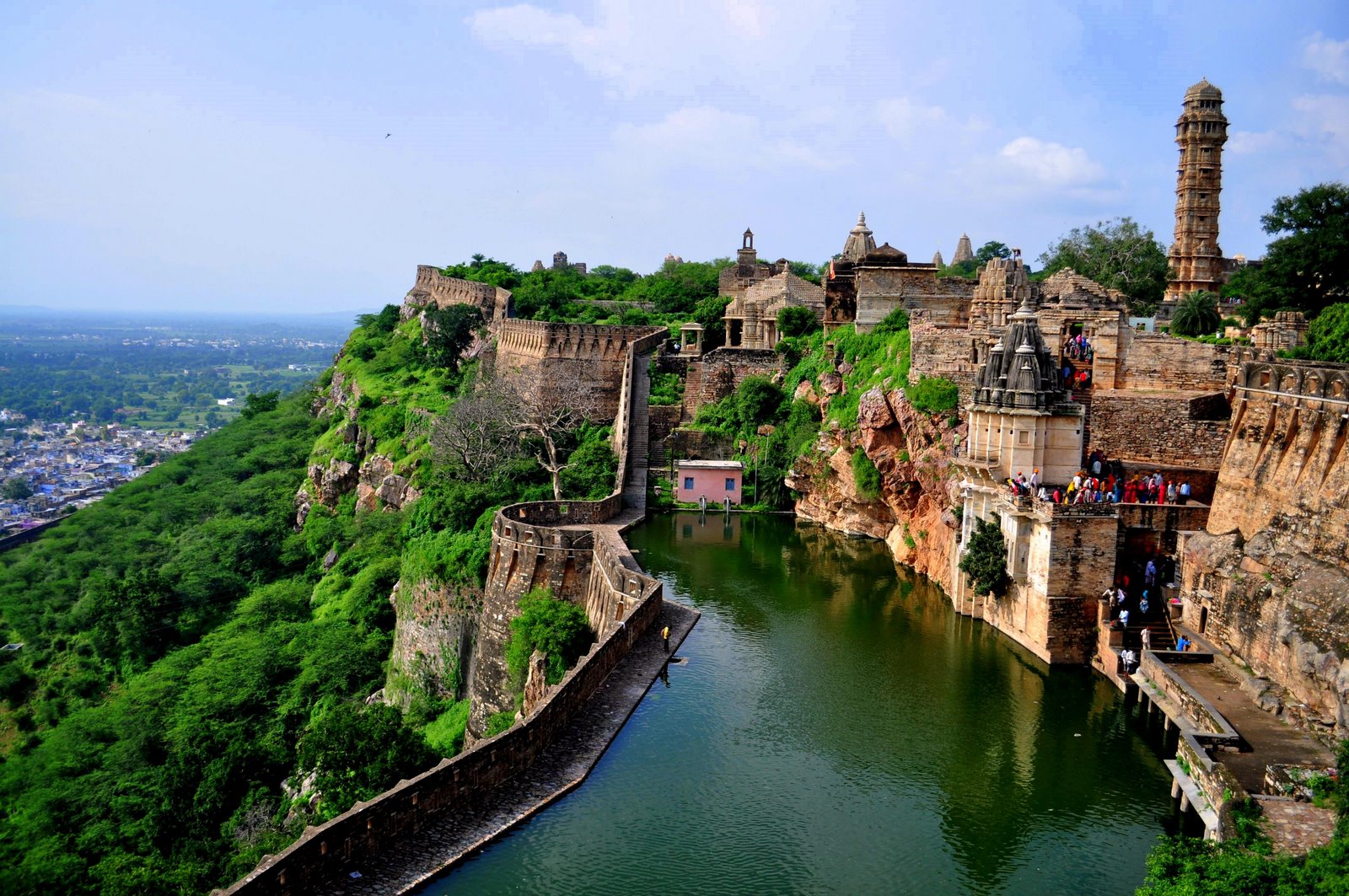
Chittorgarh fort of Rajasthan with its water tank
Take the massive fort of Chittorgarh as an example where a beautiful queen called Padmini who, along with more than a thousand of her female companions, burned herself to death by jumping into a massive fire instead of surrendering to the invading sultan of Delhi in the 12th century. It is the most massive fort in India that is named a UNESCO World Heritage Site. People will tell you that even today one can hear the shrieks of burning women in the pit during moonless nights and can hear the jingling of their ankle ornaments going to their painful death.
There are numerous forts like this with similar horrible stories all over Rajasthan. Most of the forts were built on hill tops from where the sentries could spot the approaching enemies long before their arrival so they developed an ingenious system of flashing a polished metal disc in a rapid-fire Morse code that could be read by another fort that would be then aware of the impending danger.
These forts could withstand a long siege by the enemy because they stored food and water for the population sheltering inside. They collected rainwater into a reservoir and had massive granaries and other facilities that could sustain life for months at a time. When they fell, there were tragic consequences. Women committed mass suicide and men fought until the last man fell.
This is the bloody history of Rajasthan, called the land of kings. It was a land where people lived the life of an uncertain future because they never knew when a war would break out and their sons would be forcibly conscripted to fight it and die. Their women who were pretty lived in fear of being abducted and sold to harems or into slavery that led to prostitution, so they preferred to die than to surrender. Young widows who lost their husbands in war self-immolated on the burning pyre of their husbands and left their palm print on the walls of forts.
Some of their palm prints are still visible if you visit these forts, but what will surprise you is the size of these palm prints that can only mean one thing. Some of these brave women were very, very young and even children.
The courageous self-sacrifice of Rajasthani women
![Sati Handprints at the Mehrangarh Fort [Dark Tourism in India] – Dark ...](https://darktourists.com/wp-content/uploads/2020/02/Sati_Handprints_in_Mehrangarh-fort.jpg)
Handprints of women before they self-immolated to save their honor.
The prints are now carved into stone on the walls of the fort.
There is a popular story in Rajasthan somewhere that is so tragic that it is unbelievable. There was a king who went to fight his enemy and took two pigeons with him. If he lost the war, he would release the black pigeon and if he won the war, the white pigeon would be released. These pigeons then would fly back to the fort as harbinger of good news or bad news so people inside would act accordingly. It so happened that the king won the war, but the black pigeon was accidentally released. Realizing the disaster, the king returned hastily to his fort, but only to find the huge burning pyre where hundreds of women had jumped into.
Jaigarh fort cannon

Massive cannon in Jaigarh fort near Jaipur
In many such forts you will still find the armory and other weapons like massive cannons. They display the swords, guns, armor plated vests, bows and arrows, javelins and numerous weapons. There are numerous types of daggers, knives, spikes, cannonballs filled with explosives in the museums there. There are uniforms the king and the soldiers wore, helmet and footwear for them all will show you what a warrior people they were. There are beautiful clothes on display that royals and the common women wore in those days. There are museums full of jewelry and pottery to show you.
Some of these forts have buried treasures that people speak of, but no one knows where it is buried. The fort of Jaigarh near Jaipur is one such fort where according to the common folklore a huge treasure was buried by the King Man Singh who brought it from Afghanistan after defeating the kings there. No one knew where inside the fort it was buried, but Indian Prime Minister Indira Gandhi sent a team to look for the buried treasure.
The Indian army cordoned off the entire fort and started some serious digging everywhere. No one was allowed near the fort for a long time but one night lots of Army trucks left the fort for Delhi and closed the highway for the public for several hours so people speculate what the trucks may have been carrying. No one knows even today what they found and where it was taken to.
Jaigarh fort water tank

Empty water tank in Jaigarh fort that has stairs going three floors deep where the supposed treasures of the king were buried.
When we visited the Jaigarh fort near Jaipur a few years ago, we were shown a square shaped huge cement water tank in the courtyard of the fort that had no water. A guide then showed us a small opening at the base of the raised cement pond that showed stairs going down in the darkness. The guide said it was three stories deep and that is probably where the treasure was kept in sealed vaults that the army people found and transferred the treasure to some other equally secret location. It is possible that the treasure rooms are connected by secret tunnels from inside the fort, but no one is allowed in.
Needless to say, that the long history of Rajasthan is filled with epic tales of sacrifice by women and men who still value honor and self-dignity above everything else. They are the descendants of their fierce warrior forefathers and proudly join the Indian army to fight for the country. Their bravery in battle is legendary in the military history of India. The British were wary of these fighting people who had no word for surrender in their vocabulary, so fought to death.
Rajasthani women
Rajasthani women wear colorful dress different from other women
The Rajasthan women are pretty and wear very colorful dresses that are different from what women wear in other parts of the country. You will still see them in their very colorful long skirts and wearing a lot of silver jewelry. Rajasthan is a dry state so you will see many deep wells called Baoris or step wells built long ago by the kings and queens, but now there is a massive canal over 600 kms long that brings water to the dry part of the state that helps farmers grow many crops there. The road network is being expanded, and water and electricity is being brought to villages and cities all over the state.
Stairwells of Rajasthan

Stairwells of Rajasthan
There are many stairwells built by the queens and kings to provide clean water to the population in areas where they suffered the water shortage. Even today, purple draw water from these stairwells that are unique in their design and beauty.
People now live in peace and are proud to show you their rich heritage of their forts, palaces and havelis everywhere, although it hides a bloody past.